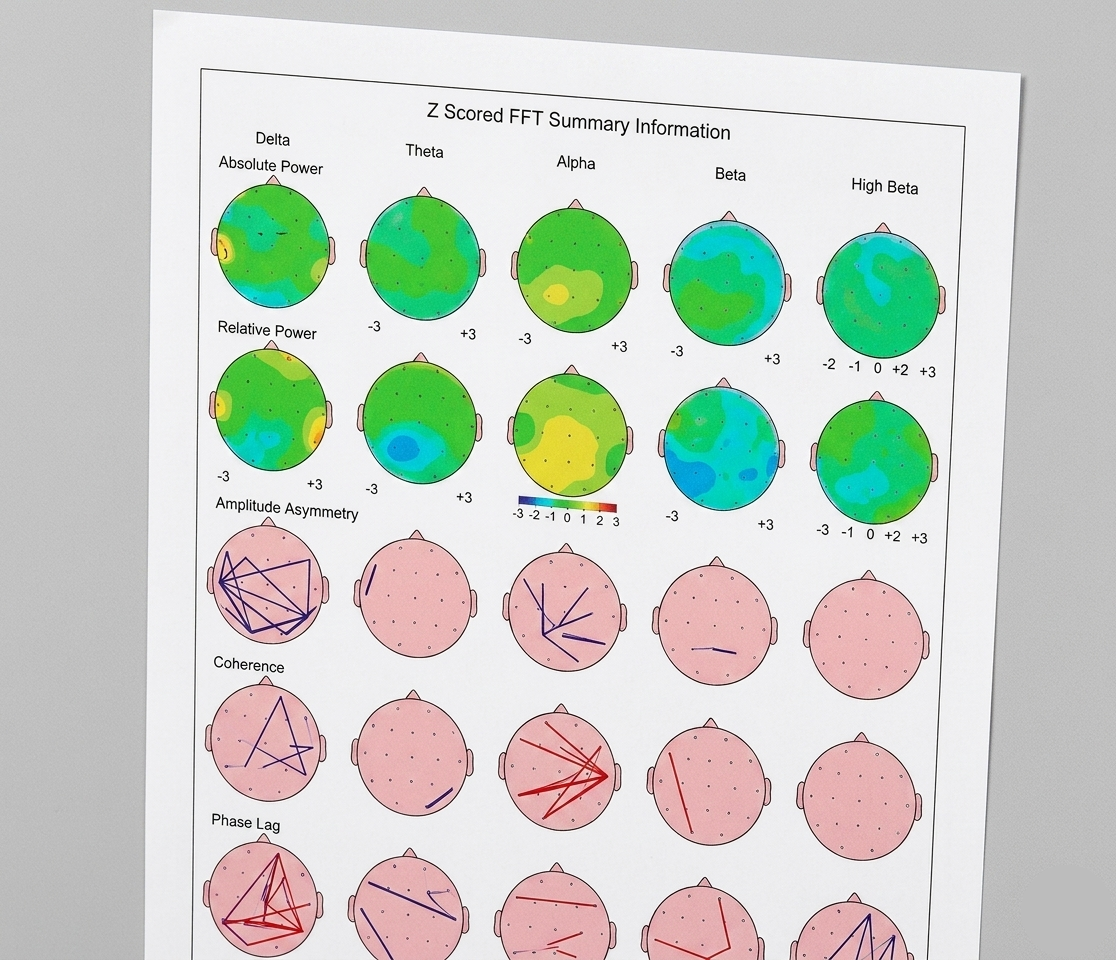
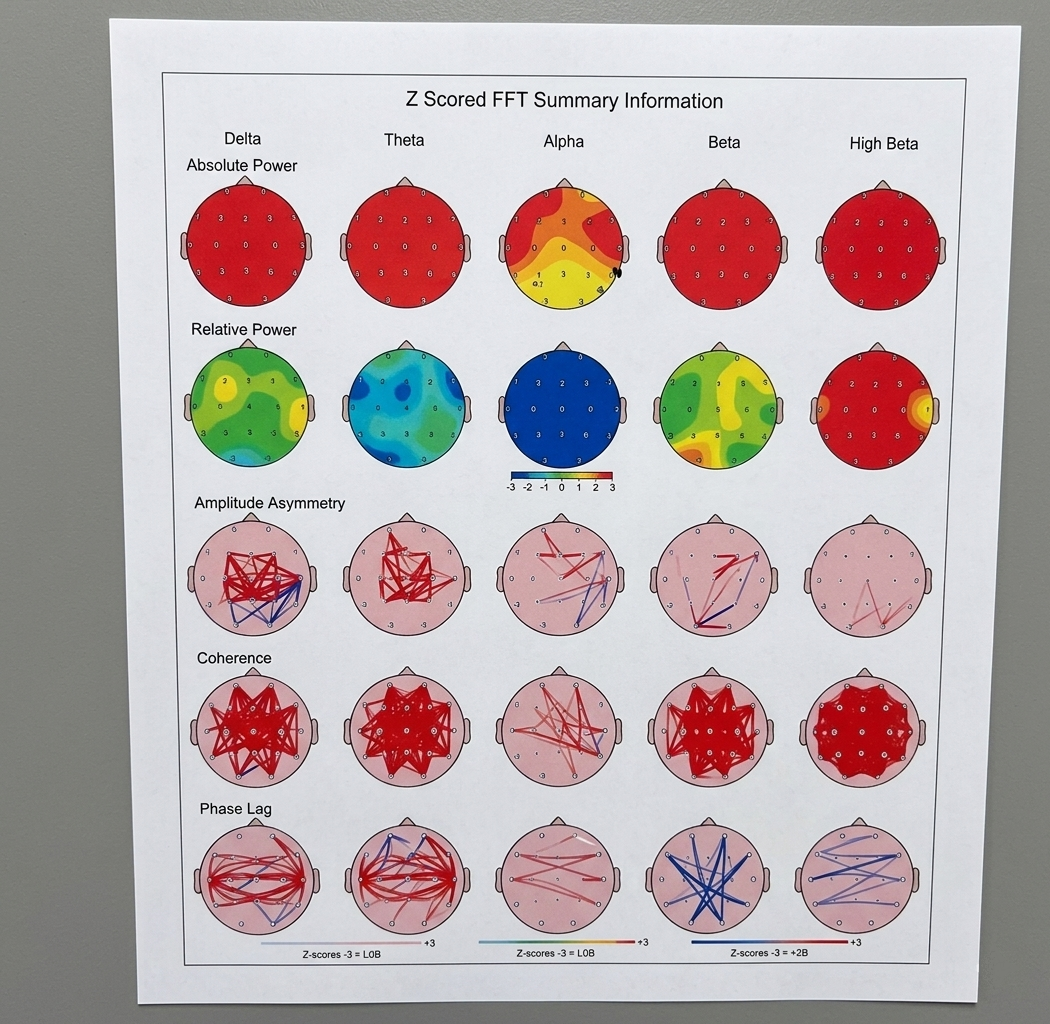
In March 2015, Kurtis Todd sat in a clinic in Sarasota while a neurologist mapped his brain in three states — resting baseline, and two deliberately induced meditative states. What the instruments recorded fell categorically outside the parameters of ordinary clinical experience.
Three states. Two results that had no precedent. A quantitative electroencephalogram — measuring amplitude, frequency, and inter-regional synchronization — was the instrument.
The normal adult brain produces electrical activity ranging from approximately 10 to 100 microvolts on the scalp, with most waking states operating between 10 and 50 μV. Alpha waves — the signature of calm, alert wakefulness — typically run below 50 μV in posterior regions. These figures are well established across decades of clinical electroencephalography.
The session documented here recorded three distinct brain states. The baseline reading placed the author's brain squarely within normal parameters. What followed did not.
Meditation Baseline
Within the established normal range. Consistent with a calm, resting adult brain.
Meditative State A
Already beyond the upper boundary of what standard scales account for.
Meditative State B
Seven times the upper boundary of normal human experience. Categorically outside the scale.
Clinical literature establishes the normal adult scalp EEG range as 10 to 100 microvolts, with the majority of waking activity occurring between 10 and 50 microvolts. Seventy microvolts is exactly where a healthy brain at rest belongs. Seven hundred is not on that scale.
Neuroscience has established that one of the brain's most significant organizational features is cross-frequency coupling — the way slower oscillations coordinate and modulate faster ones. Theta rhythms (4–8 Hz) organize gamma activity (30–80 Hz) in regions associated with working memory, attention, and conscious awareness. Researchers have proposed that this hierarchical coordination may be a prerequisite for consciousness itself — breaking down under anesthesia and in cognitive decline, and intensifying in states of heightened integration.
Buzsáki & Watson (2012); Axmacher et al. (2010); Voytek et al. — published in PMC / Frontiers in Neuroscience
EEG coherence measures how synchronously distant brain regions fire together — a direct index of large-scale neural coordination. Anomalous coherence patterns, whether hyper- or hypo-coherence, are recognized as clinically significant departures from baseline function. Hypercoherence between regions that do not ordinarily synchronize at high levels has been documented as one of the most striking findings in the literature on altered and exceptional states.
Frontiers in Neuroscience (2025); PubMed — inter-hemispheric coherence literature
Amplitude is measured in microvolts — one millionth of a volt. The normal adult brain produces scalp readings between 10 and 100 μV, mostly in the 10–50 μV range. Deep sleep pushes delta activity above 75 μV. Epileptiform discharges — considered clinically urgent — are defined by their anomalously high amplitude. A sustained, intentionally induced state producing 700+ μV in a waking subject represents a measurement without a ready category in standard clinical practice.
LearningEEG.com; StatPearls / NCBI; Medscape EEG Waveforms Reference
The states documented here were not spontaneous, random, or artifactual. They were entered through deliberate, sustained conscious intention — repeatable across the session. The physiological cost was real: like sustained muscular exertion, these states depleted something the body then needed to recover. This combination — intentional induction, documented amplitude, anomalous coherence, and physiological cost — defines what was recorded as a structured, reproducible phenomenon.
qEEG session · Sarasota, Florida · March 2015
Baseline · Head map
Meditative State A · Head map
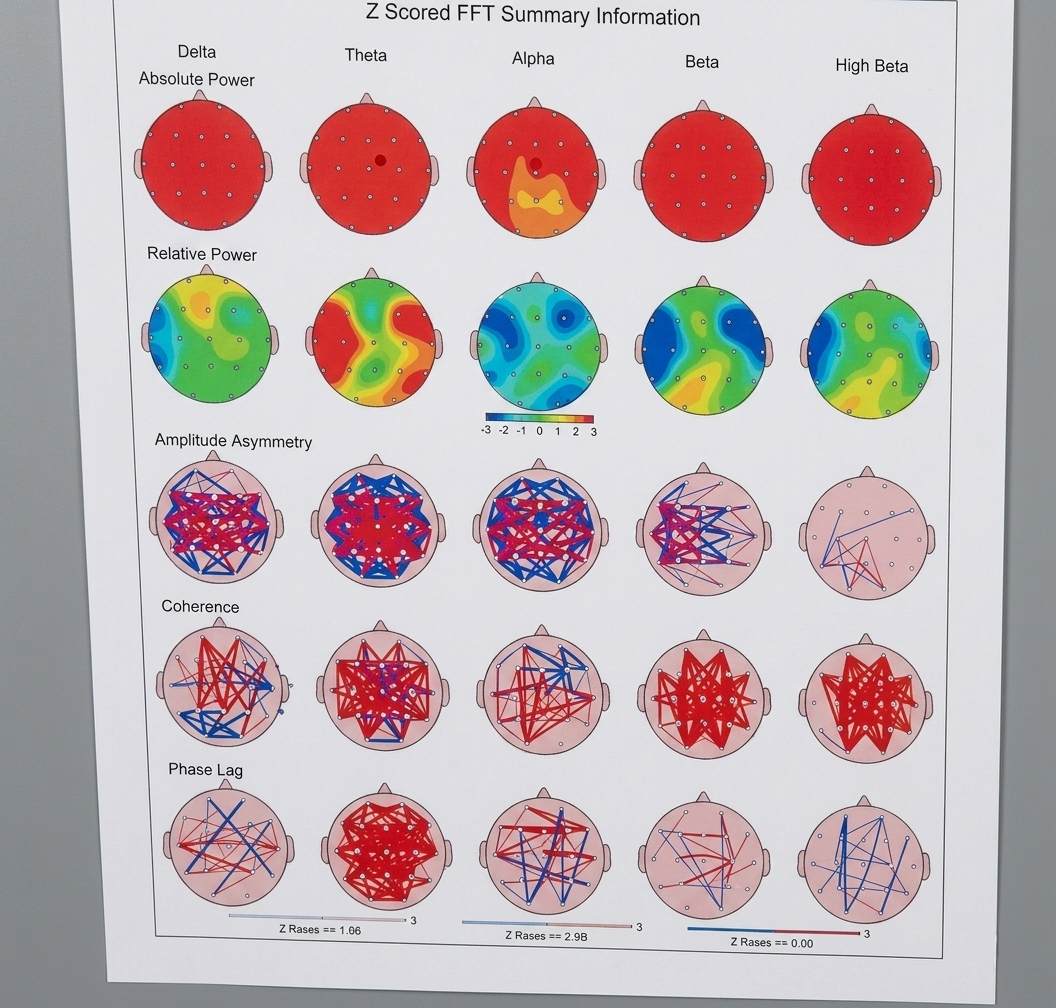
Z-score and frequency graphs were recorded for the two induced states only, not the resting baseline.
Baseline · No frequency graph
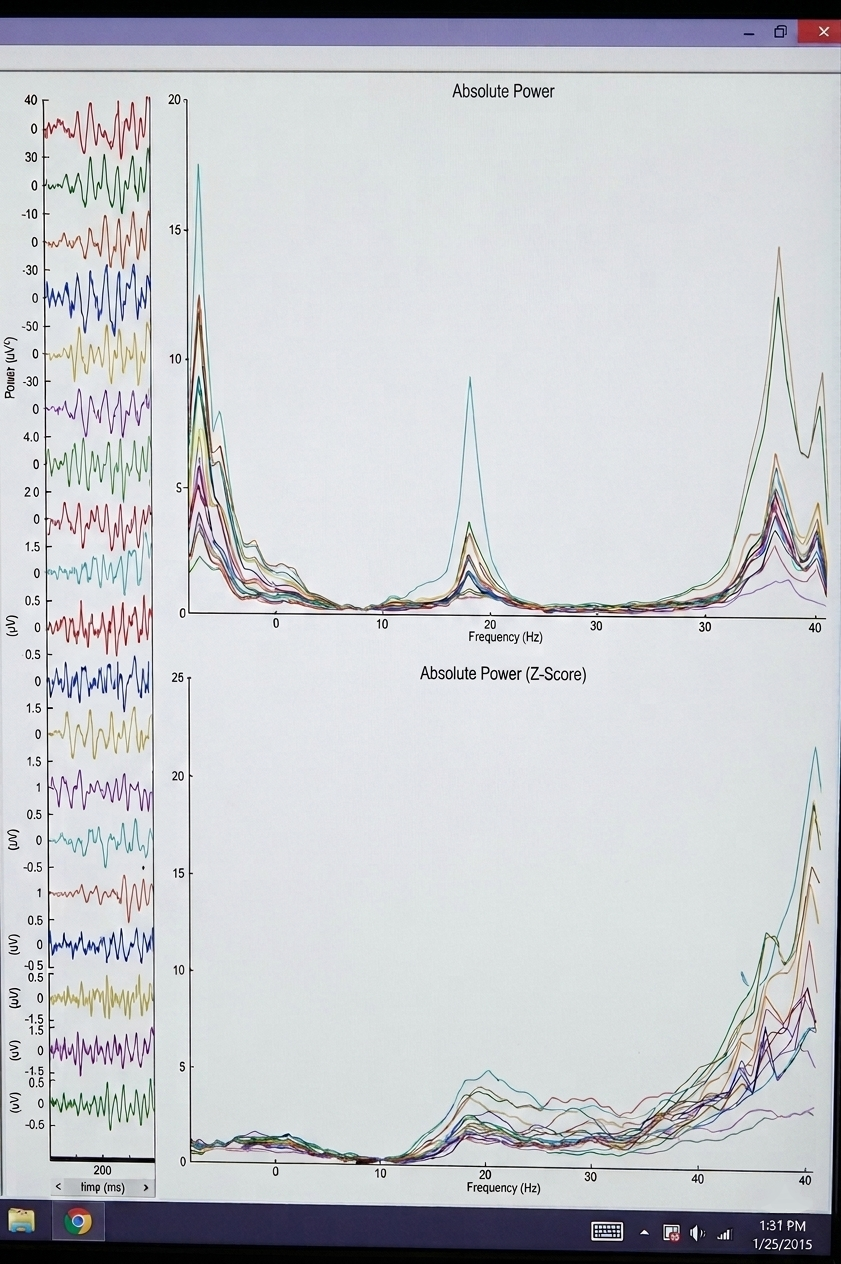
Meditative State A · Z-scores & frequency
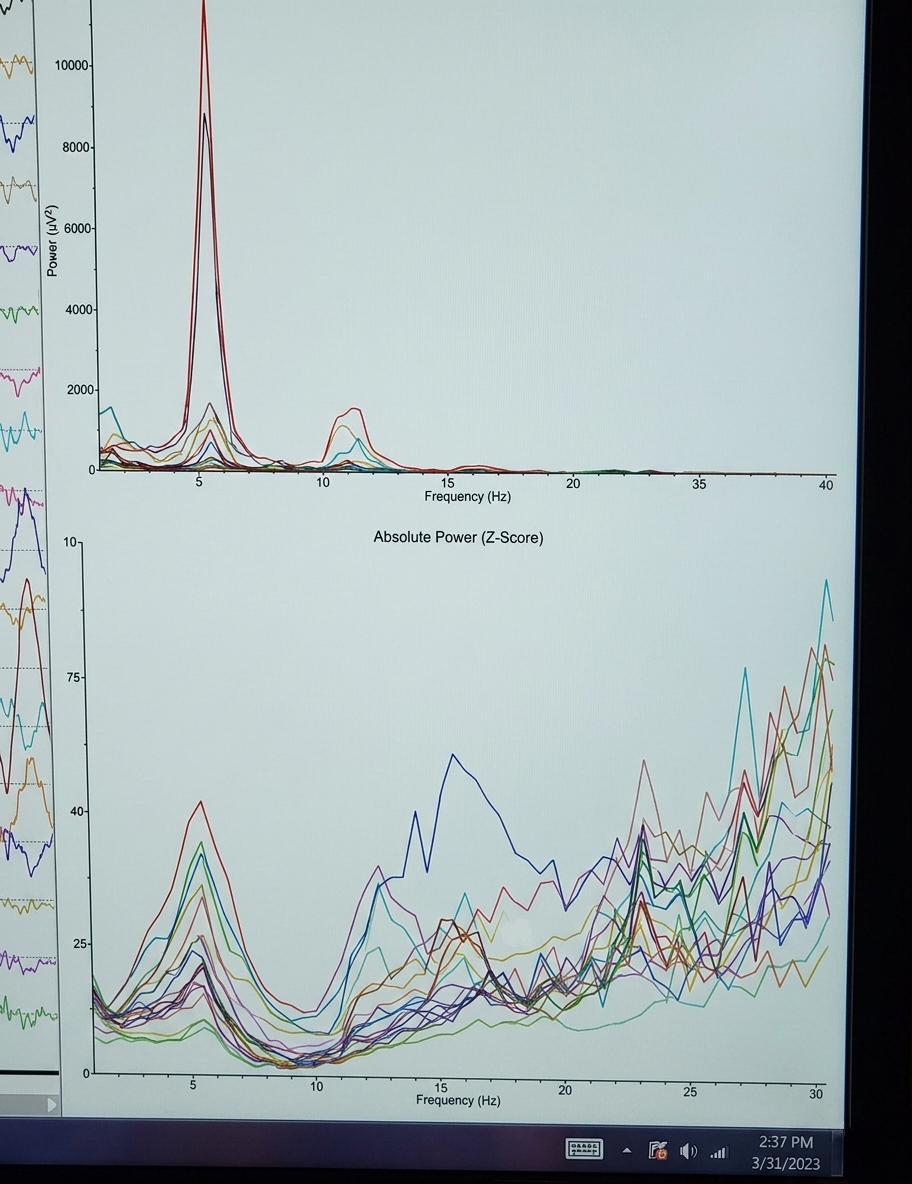
All scans recorded March 2015 · Sarasota, Florida · Quantitative Electroencephalogram (qEEG)
Beyond the amplitude readings, the session documented anomalies in other metrics — patterns in inter-regional communication that fell outside the parameters of ordinary clinical experience.
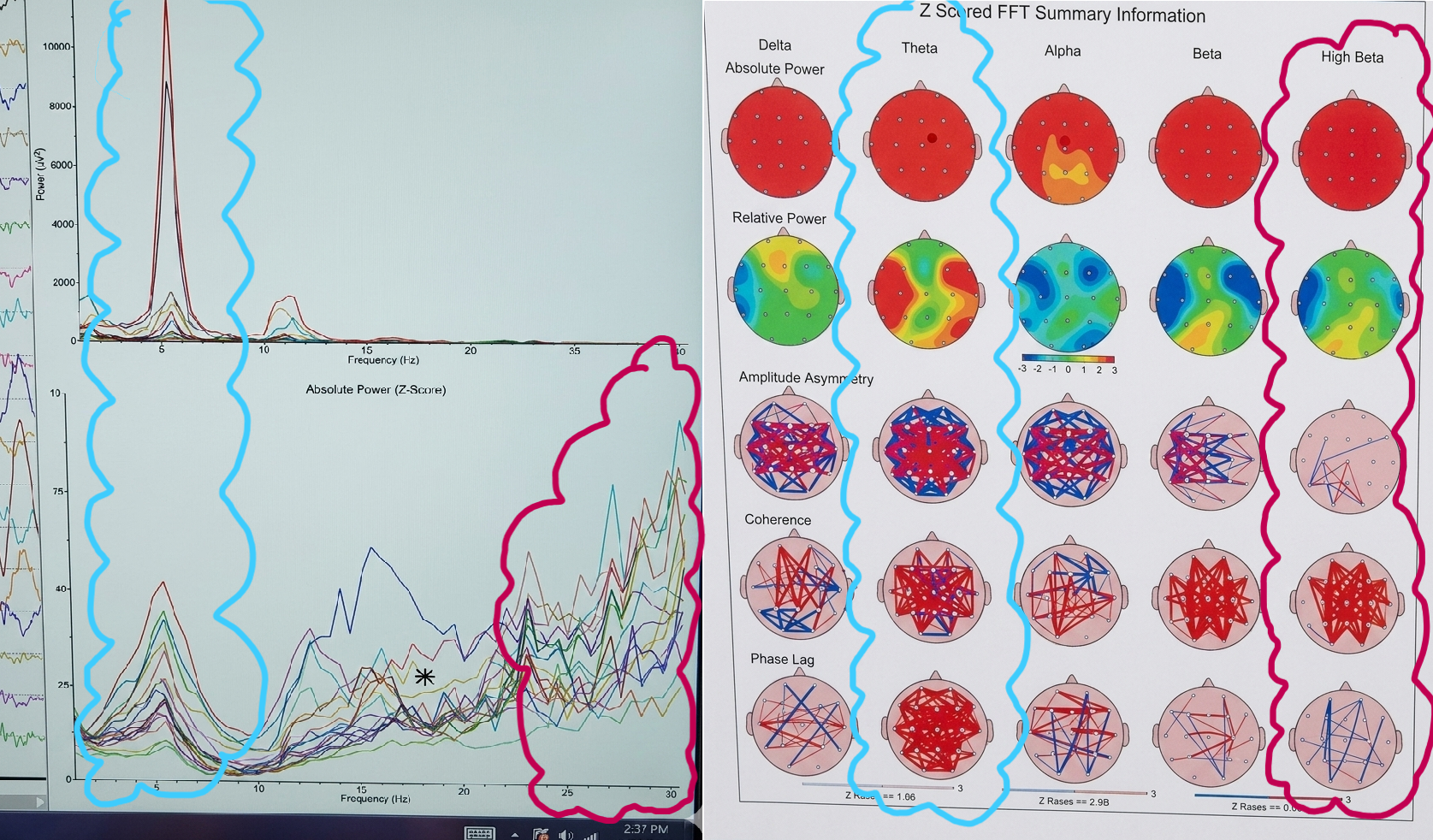
Annotated State B Reading
Blue
Theta 6-7 Hz
Red
High beta 25-30+ Hz
Panel guide
Top-left: absolute power (uV) by frequency · Bottom-left: z-scores by frequency · Right panels: topographic head maps · Red on maps = highest readings, blue = lowest
Top-left graph — blue annotation
The Theta Spike — Above 1,000 uV
That spike annotated in blue at 6-7 Hz is the dominant theta peak. Horizontal axis: frequency in Hz. Vertical axis: total power in microvolts. The peak reaches above 1,000 uV. Normal waking brain states peak below 50 uV. Sleep's highest synchronized delta reaches roughly 75 uV. This is more than ten times that figure, in a deliberately induced waking state.
Bottom-left graph — red annotation
High Beta Z-Scores — Beyond the Display Ceiling
The bottom-left graph shows z-scores — deviation from population norms, not raw power. The red-annotated high-beta peaks are the highest on the chart, appearing to reach and potentially exceed the display ceiling at 30 Hz. The chart stops there because that is where standard clinical qEEG display conventions end — not because the activity stops.
High beta having the highest z-score does not mean it is louder than theta. It means high beta is more anomalous relative to population norms for that frequency. Theta still dominates in raw amplitude by a large margin. Both readings are anomalous. They are measuring different things.
Right panels — blue annotation on head maps
Theta Dominates Every Measured Parameter
The head maps show theta (blue annotation) as red — saturated — across every measured parameter: relative power, coherence, phase lag, and others. Values appear to reach or exceed the display ceiling in multiple parameters. The precise z-score figures require confirmation from the neurologist's raw data. What the maps show visually is unambiguous: theta is the organizational frequency of the entire brain state, expressed in every dimension the instrument measured.
Right panels — red annotation on head maps
High Beta — Anomalous in Z-Score, Quieter on Maps
The head maps show comparatively less spatial activity in high beta than theta — but the z-score values are numerically the highest of any frequency band. This is the cross-frequency coupling signature: theta is the dominant carrier wave, large in amplitude and widespread in cortical expression. High beta is the coupled passenger, anomalously elevated in relative terms, carried farther by the theta than it would propagate independently. The slow wave organizing the fast one.
The relationship between the two annotations is the finding: a high-amplitude theta state carrying simultaneously elevated high-beta activity. Theta dominant in raw amplitude and spatial expression. High beta anomalous in z-score. The organism synchronized across frequency ranges simultaneously. What the research calls the neural correlate of integrated conscious states.
The framework calls it ontological resonance — the structural correspondence of the creature with the operational level of reality becoming sufficiently precise that the ground expresses locally through that form at an amplitude the individual organism cannot generate from its own metabolic resources alone. The data does not prove this interpretation. It is consistent with it in a way that no available alternative adequately accounts for. Measurable. Measured here.
All readings: March 2015 · Sarasota, Florida · Annotated by Kurtis Todd
The Meditative State B produced over 700 microvolts — categorically outside the 10–100 μV range of normal human waking states. Clinical literature places peak alpha rhythm below 50 μV, and sleep's highest synchronized delta activity at roughly 75 μV. Seven hundred microvolts in a deliberately induced waking state has no standard category.
The data revealed striking, unusual patterns in how brain regions were coordinating with each other. EEG coherence — the measure of synchronized firing between distant brain areas — is one of the most sensitive indicators of large-scale neural organization. What was observed fell outside the parameters of ordinary clinical experience.
The states were not spontaneous. They were entered through deliberate, conscious intention and sustained with practice — not random neurological events, but a repeatable capacity. Cross-frequency coupling research demonstrates that the brain's hierarchical organization of oscillations can be dramatically altered by intentional states. What was captured here represents an extreme end of that spectrum.
Like sustained physical effort, these states carried measurable physiological cost. What the body expended, the body needed to recover — physical law, operating at a level most clinical settings have never had occasion to document.
The Question the Data Raises
The brain does not generate its own energy. It converts metabolic resources — glucose, oxygen, blood flow — into electrical activity. Neural firing is metabolically expensive. The brain at rest already consumes approximately 20% of the body's total energy output despite representing only 2% of its mass. Every additional increment of amplitude and synchronization carries a corresponding metabolic cost.
A 10× increase in amplitude does not simply happen because a person decides it should. The body has a finite metabolic capacity. The individual organism, operating within its ordinary resources, does not have a lever marked "produce ten times more synchronized electrical activity." The finite endurance of the state — documented in the session — is itself evidence of real metabolic demand. The structure could sustain it for a limited duration, then could not.
This raises a straightforward question: if the individual's ordinary metabolic resources are insufficient to account for the amplitude recorded, what is the additional source?
The framework's answer: when the structure of the creature is sufficiently reorganized to correspond with the operational level — the Logos — the ground expresses locally through that creature with a force that is not the creature's own. Not as an external intervention. As the natural consequence of structural correspondence. The creature does not generate the amplitude. It receives it — because its structure has been built, over time, into the kind of form through which the ground can express at that level. The organism drawing on a source larger than itself. Not metaphorically. Measurably.
This interpretation is the framework's account of the data. It is not the only possible account. What is not in dispute: the amplitude was real, the metabolic cost was real, the individual's ordinary resources are insufficient to explain it, and the state was finite. The framework provides the most coherent explanation for the pattern. Materialism has not.
How It Was Built
This did not happen suddenly. It was not a gift or an accident or a single moment of breakthrough. The session recorded in March 2015 documented the result of approximately a decade of deliberate, structured, daily practice — applied not just consciously but subconsciously, running through the whole system, reorganizing it from the inside.
The process works like training a muscle. The muscle does not grow because you understand how it grows. It grows because you apply the correct load, consistently, over sufficient time, and the body reorganizes at the structural level in response. The reorganization is physical. It is incremental. And it happens below the level of conscious intention — the subconscious and the body changing their organization because the conditions for that change have been created and held.
The same principle applies here. The conscious mind understood the framework — but understanding is not structural change. The subconscious and body had to reorganize to correspond with what was understood. That reorganization happened slowly, through years of practice, each increment of structural change enabling a slight increase in structural correspondence with the operational level. Each increase in correspondence allowing slightly more of what the ground expresses to flow through locally.
The Horizontal Dependency
The conscious and subconscious minds are horizontally dependent — neither side can change unilaterally. You cannot consciously will a subconscious reorganization any more than you can consciously will a new muscle fiber. What you can do is create the conditions, consistently and in the right sequence, under which the reorganization occurs on its own at the structural level. This is why the practice must be embodied, repeated, and sustained — not merely understood.
The Vertical Cascade
As the horizontal structure reorganizes — brain and body, conscious and subconscious gradually coming into coherence — the structural correspondence with the vertical source changes. The creature does not pull the ground toward it. The creature clears the obstruction. The foundation expresses through whatever structural form is available to it. A more precisely organized form allows a more complete local expression. The cascade flows downward through the reorganized structure — reinforcing it, deepening it, making possible what the structure could not have held before.
The 70 μV baseline is not the starting point of the practice. It is the starting point of the session. The 700+ μV is not a miracle. It is the end of a decade. The gap between them is not mystery — it is the cumulative result of structural reorganization applied over time, incrementally, consistently, and in the right sequence. What the session measured was not an exception to the framework. It was the framework — operating exactly as described, made visible by the instruments.
A Note
No need to fret. The concepts described here — structural correspondence, ontological resonance, the horizontal and vertical dependency structure, the cascade — are the conclusion of a nine-chapter argument built from the ground up. They are not meant to be grasped in isolation.
The book and the Application Manual are a deliberate and systematic approach to understanding and implementing this structure — designed so that each piece arrives in the order that makes the next one possible.
To allow the infinite comprehension to slowly localize.
Start at the Beginning → How the System Works →"I drove home that evening no longer wondering. The instruments had seen what I had felt. What I had been experiencing was not a narrative I was constructing to comfort myself. It was not mysticism. It was not self-delusion. It was measurable, physical, and real — documented in the most literal and empirical and gloriously undeniable sense of those words."
"The question I turned over the entire drive home was the only one that had ever really mattered: what is actually happening here, and why?"
— from the Preface, Infinitely Simple